First-hand · verified against the real thing
HDMI-ARC, eARC or optical: the one cable that decides how the soundbar sounds
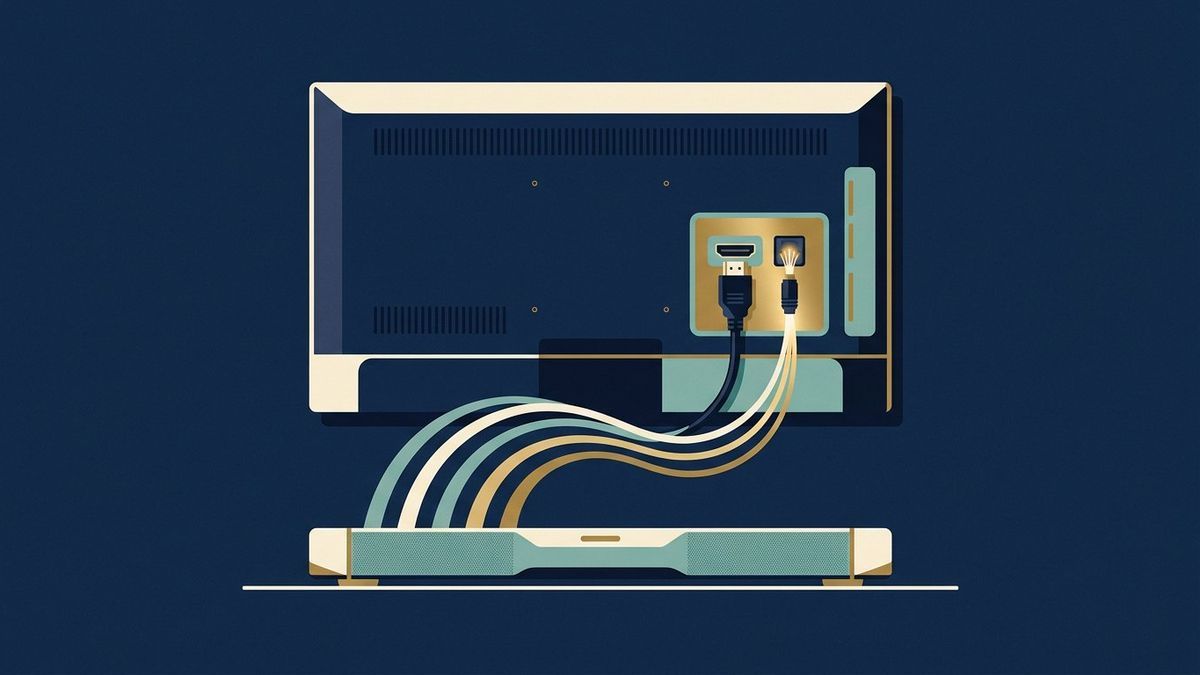
In one line: Why the cheapest connection on the box can carry the worst audio, the TV menu that quietly overrides your wiring, and Dolby Atmos's real requirement.
Ask why the fancy soundbar "only sounds alright" and the answer is usually not the bar - it is the three-metre-old habit at the back of the TV. Two connections carry digital audio from TV to bar - optical TOSLINK and HDMI ARC/eARC - and they are genuinely different pipes with different capacities, different failure modes, and a setting on your TV that silently decides which one your money actually used.
What each pipe can carry
- Optical is the older, universal one - glass fibres, plug and play, immune to ground-loop buzz - and it tops out at compressed 5.1. It cannot carry Dolby TrueHD or DTS-HD MA lossless, and it cannot carry Atmos as anything except the DD+ sidecar. On any TV that offers HDMI audio, choosing optical is choosing the TV's own compression.
- HDMI ARC (Audio Return Channel - the TV's HDMI port labelled ARC) carries compressed 5.1 and DD+ Atmos like optical but on the cable you already needed; its edge cases are CEC flakiness (devices waking each other, volume keys that sometimes work) and the fact that "ARC" on both ends was sometimes the version nobody tested against the other's.
- eARC (enhanced ARC, on the current HDMI standard generations) adds the bandwidth for lossless bitstream: TrueHD, DTS-HD MA, and Atmos/DTS:X as full objects instead of a downmix. If the bar has an HDMI input - games console, streamer - eARC plus the bar's own decoding is also the answer to "the TV downmixes anything that passes through it."
The menu that overrides your cable, and the fix
Most sets ship with the audio output still on "TV speakers" or "optical preferred", and CEC - the switching brain - disabled under a brand's marketing name (Simplink, Anynet+, Bravia Sync, Emplink). eARC without CEC enabled is a cable to nowhere: enable CEC, select the ARC/eARC output, set the TV's digital audio out to "Pass-through/Bitstream" so the TV stops converting Dolby to PCM (the conversion is where Atmos dies), and power-cycle both devices once with the cable seated in the labelled port - a bar in the plain HDMI-1 port is not ARC, no matter what the box promised at the till. The last tell worth knowing: if the bar's display says "Dolby Digital" while your streamer is playing an Atmos title, something upstream is compressing - walk the chain backwards (streamer settings, TV, then the bar) and the eARC negotiation will show its work on whichever menu names the format.
The honest buying note
Optical is not a scam - it is the right port for a 2012 TV, a noisy ground-loop, or a setup where CEC tantrums end marriages. But "we'll just use the optical we have" is the audio equivalent of paying for 4K and watching 720p: the soundbar's most expensive features live downstream of a pipe that was never asked for. One eARC cable, three menus, and the bar finally gets the signal it was bought to decode.
Next