Maintain it · practical guide
Big holes, small holes, block walls: the patch and anchor map that holds
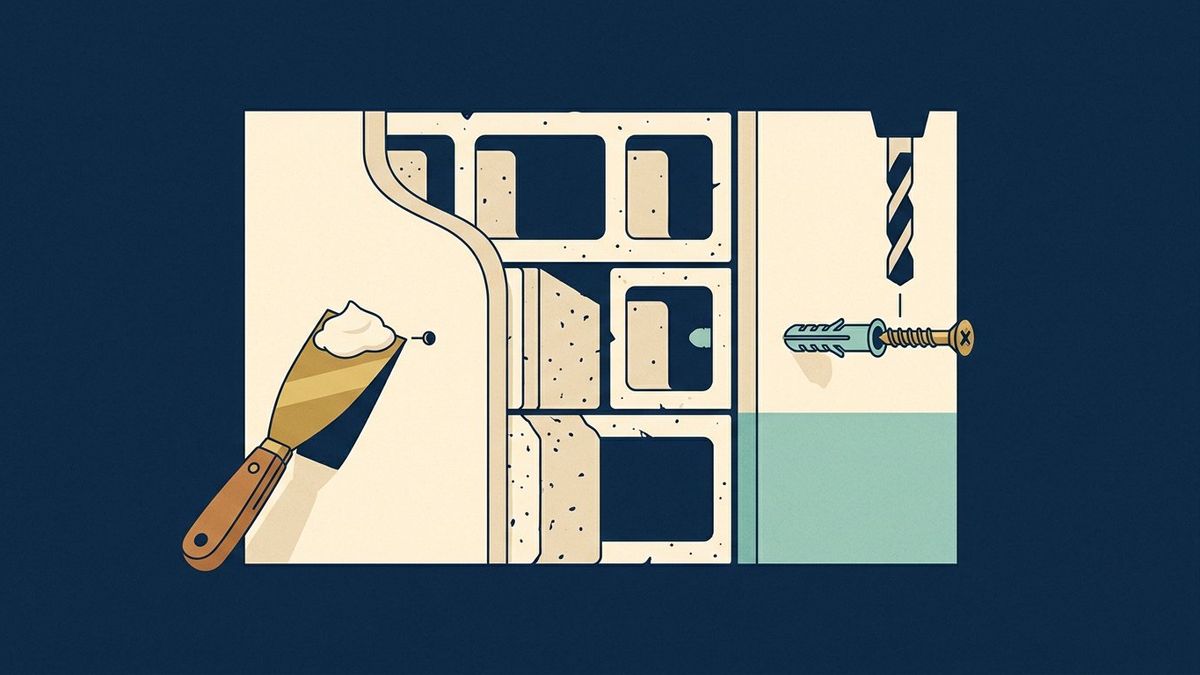
In one line: The plug-to-hole arithmetic for concrete blocks, why the palm-size patch cracks next year, and the filler that wants a painter's patience.
Every wall in every house is either a picture's friend or a shelf's enemy, and the difference lives in two decisions the desk sees made backwards constantly: which anchor for the load, and which filler for the hole. Get both right and the wall forgets you ever had plans for it; get them wrong and next year's repaint shows this year's mistake.
The anchor map, by wall and weight
- Block and concrete (the load-bearing majority here): the plastic "red plug" family sized to the drill bit - the number stamped on the plug is the bit, and the drill is to be the same size for the depth of the plug's body, no deeper, or the screw bottoms in air behind it. Light: the 6 mm standard for pictures and rails. Medium: the 8-10 mm plugs for curtain rails and mirrors, one plug per fixing, and two fixings per bracket leg on a curtain rail.
- Anything that matters more than the wall: a TV, a gas cylinder bracket, a child's climbing hold - chemical anchor or a sleeve anchor into solid block, or into the structural band where the blocks are solid-filled (the courses behind doors and windows - a fixing punched into a hollow shell block is the TV-on-the-floor story). The mount guide covers the geometry; this covers the physics.
- Board-over-block and plasterboard-only walls: the self-drive plastic anchors and the toggle family carry the "no wall behind the plaster" problem - toggles flip flat against the back and spread the pull across a coin's width. They hate paint-thickness and they hate over-tightening; snug, not final.
The patch arithmetic that decides next year's paint
Nail holes and plug holes: ready-mix filler on a flexible putty knife, pressed in from two directions to leave a slight proud smear, then sanded flat once it shrinks - the "proud then flush" order is why the DIY spackle dips into its own dent next month. Palm-size damage (the door handle's answer to an open door): the tape-behind and skim-everywhere shortcut always telegraphs under paint; the honest repair is a piece of cut board bridged on screws, taped seams, and three thin coats of filler - a sandwich the wall would rather have than a hill to repaint. The one-hole special case: fill a plug hole and it hides forever, so plan the furniture move before the repaint and the whole wall is one decision, not a constellation of them.
The desk's two closing rules
Anything with a cord, a gas line or a water pipe behind the drill path: a torch, a look inside the cupboard where the run goes, and the stop-before-you-spin rule the wiring chapters already carry for a reason - walls keep secrets exactly where you didn't ask. And when in doubt about the anchor: one size heavier than the maths, because a hole that gets wider is a hole that has to be filled, which is this page's own repair in its own future.
Next
Related on this desk.
General information, not professional advice. Homes differ — if a job is beyond your confidence or the guide’s boundary, that is what tradespeople are for.